

How Does a Drip Irrigation System Work?
A drip irrigation system delivers water slowly and directly to the root zone of plants through a network of pipes and small outlets called emitters. It does not spray water across a whole area. Instead, it releases a measured amount at each plant, usually a few litres per hour, so almost nothing is lost to evaporation, run-off or wind drift.
A working drip system has four main parts:
- Emitters and pipe deliver the water.
- Filters and pressure regulators protect the system.
- A timer or controller decides when it runs and for how long.
- A planned layout makes sure every plant gets an even share.
Whether you are planning your first system or upgrading an existing one, this guide takes each part in turn so you can see how the whole thing fits together.
What Are Emitters and How Do They Deliver Water?
Emitters, also called drippers, are the small outlets that control how much water reaches each plant. Emitters are rated in litres per hour (l/h), and 2 l/h, 4 l/h and 8 l/h are the most common ratings. You can buy drip irrigation in two main forms: inline drip line and individual drippers.
Inline Drip Line
Inline drip line is flexible polyethylene pipe with emitters built into the wall at set spacings, typically every 30cm or 50cm. It is quick to lay and gives an even band of moisture along its length. That makes it ideal for hedges, vegetable rows, borders and densely planted beds.
Individual Drippers
Individual drippers are punched into blank supply pipe, usually 16mm, exactly where you need them. You can also connect them to micro tube to reach a specific plant. This gives you full control over placement and flow, which makes them the better choice for containers, hanging baskets, trees and widely spaced shrubs.
Why Pressure Compensation Matters
Pressure-compensating (PC) emitters contain a small diaphragm that keeps their output steady across a range of pressures. Without pressure compensation, drippers at the start of a long run or at the bottom of a slope release more water than those at the far end or higher up. PC emitters remove that imbalance. Every plant gets the same amount whether it sits first or last on the line. On sloping ground or longer runs, we always recommend pressure-compensating drip line or drippers.
Why Do Drip Systems Need Pressure Regulators and Filters?
Drip irrigation runs at much lower pressure than mains water. Most drip systems work best at around 1 to 2 bar, while household mains pressure is often 3 bar or more. Emitters also have very small openings, so dirt that a sprinkler would pass without trouble can block them. For both reasons, a regulator and a filter should be at the head of every drip system.
Pressure Regulators
A pressure regulator reduces incoming pressure to a steady level the drip line is designed for. If pressure isn't controlled, several things can go wrong:
- Fittings can blow off.
- Drip line can split or balloon.
- Emitters can squirt rather than drip, which wastes water and washes soil away from roots.
- Components wear out faster, even when no failure is visible.
Filters
A filter traps sand, grit, algae and organic matter before it reaches the emitters. Disc and screen filters of around 120 mesh (roughly 130 micron) are standard for drip systems. Blocked emitters are the most common cause of dry patches in a drip system, so a filter is essential rather than optional. This is especially true if you draw water from a borehole, water butt, tank or reservoir. Clean the filter regularly, particularly at the start of each season.
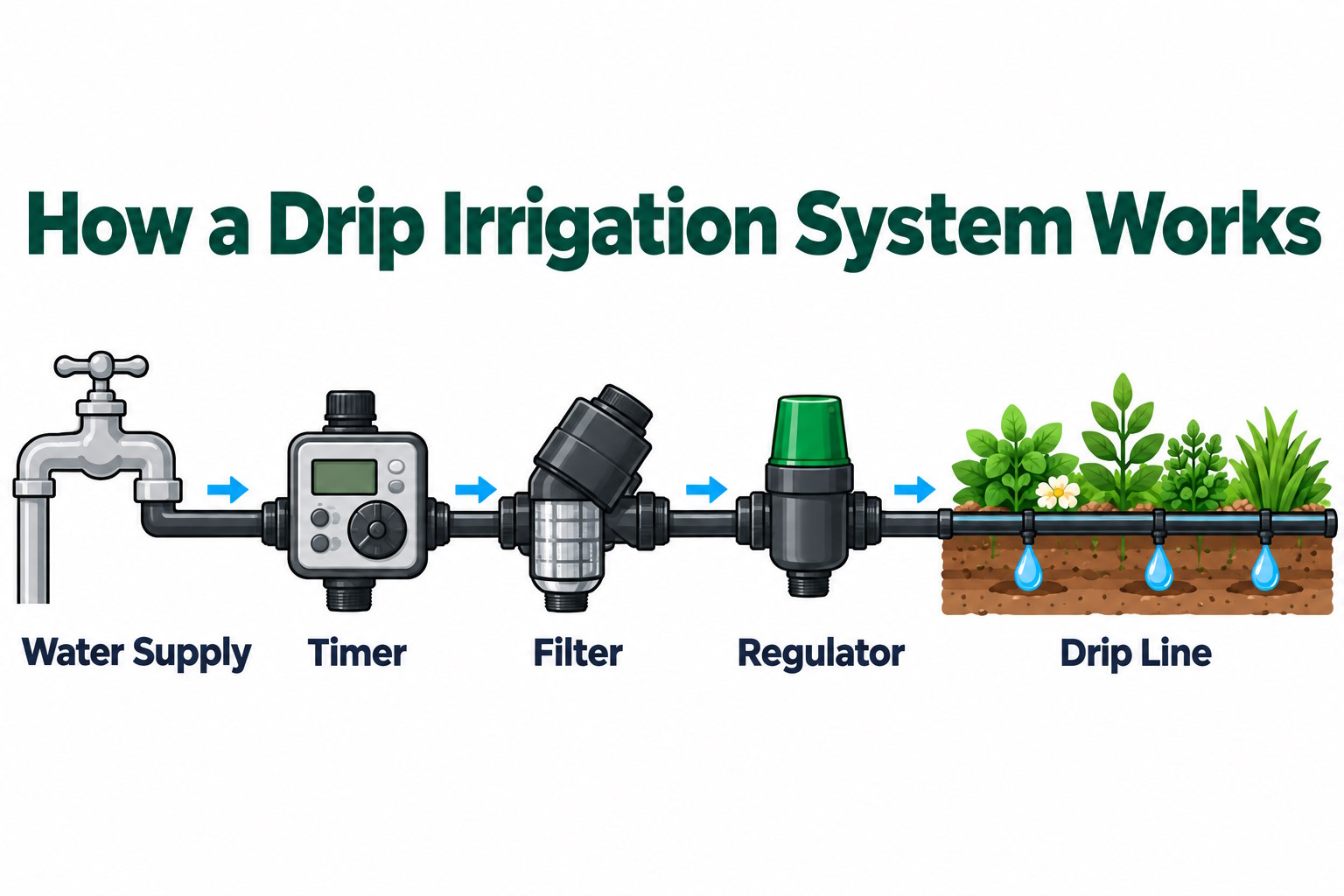
The usual order at the head of the system is:
- Water supply
- Timer
- Filter
- Pressure regulator
- Drip line
How Do Timers Automate a Drip Irrigation System?
A timer or irrigation controller switches the water on and off automatically, so your plants are watered consistently even when you are away. Simple battery tap timers suit a single zone fed from an outside tap. Multi-station controllers operating solenoid valves let you run several zones independently, each with its own schedule.
How Drip Schedules Differ from Sprinkler Schedules
Drip and sprinkler schedules are set up very differently because the two systems apply water at very different rates:
- Sprinklers apply water quickly over a wide area, so run times are usually short, often 10 to 20 minutes.
- Drip systems apply water slowly at the root zone, so run times are longer, commonly 30 to 90 minutes. The aim is to let moisture soak down and spread sideways through the soil.
How often to water depends on soil type, weather and planting. Sandy soils and containers need shorter, more frequent cycles. Clay soils hold water longer and suit fewer, deeper waterings. Early morning is the best time to water, because evaporation is lowest then.
Keep drip and sprinkler areas on separate zones. Their flow rates and run times are so different that combining them always leaves one area over- or under-watered.
How Should You Plan a Drip Irrigation Layout?
A good layout means even watering, fewer problems and easy maintenance. Before buying any components, measure your beds, note any slopes and check the flow rate available from your water supply. To check flow, time how long your supply takes to fill a bucket.
Run Lengths
Every drip line has a maximum run length. Beyond that length, pressure drops too far for the end emitters to perform properly. The limit depends on pipe diameter, emitter spacing, flow rate and whether the emitters are pressure-compensating. As a general guide:
- 16mm PC drip line can often run 50 to 100 metres.
- Non-PC drip line should be kept shorter.
Always check the manufacturer's run length tables. If a run is too long, feed it from the middle or from both ends, rather than one end only.
Zoning Larger Beds
If the total flow of all your emitters exceeds what your water supply can deliver, split the area into zones and water them one after another. Grouping plants with similar needs into the same zone also helps. For example, put containers, vegetable beds and established shrubs on separate zones so each gets the right amount of water.
Secure Pipe Placement
Drip line should lie flat against the soil, close to the plant stems, and be held in place with pipe pegs roughly every metre. Covering it with mulch protects the pipe from UV damage, reduces evaporation and keeps it out of sight. Fit end caps or figure-of-eight ends, and flush the lines through before closing them off, so debris from installation doesn't block the emitters. Avoid sharp bends that can kink the pipe, and use elbows or tees at corners.
Key Takeaways
- A drip irrigation system delivers water slowly to the root zone through emitters.
- Use inline drip line for rows and dense planting, and individual drippers for containers and spaced plants.
- Choose pressure-compensating emitters for slopes and longer runs.
- Always fit a filter and a pressure regulator at the head of the system.
- Drip schedules use longer run times than sprinklers, and the two should run on separate zones.
- Respect maximum run lengths, zone larger areas and peg pipe securely.
Build Your Drip Irrigation System with Confidence
Whether you are watering a few raised beds or a large commercial planting scheme, we stock everything you need. Our range includes drip line and drippers from brands such as Netafim, as well as filters, pressure regulators, controllers and fittings. With over 30 years of experience designing irrigation systems, our team is always happy to help you choose the right components or plan a layout that works first time.
Browse our Drip Irrigation range today, or give our team a call for friendly, expert advice!
Recent Posts
-
How Does a Drip Irrigation System Work?
A drip irrigation system delivers water slowly and directly to the root zone of plants through a net …27th Oct 2026 -
What Is Drip Irrigation and When Should You Use It?
If you've spent any time researching efficient ways to water a garden, sports surface or equestrian …15th Oct 2026 -

ECB County Grants Fund 2026: How Cricket Clubs Can Plan Ground and Facility Improvements
If your cricket club has been putting off ground improvements because of the cost, there's a funding …1st Sep 2026