
How to Water a Cricket Square: A Practical Guide to Cricket Pitch Irrigation
Ask any groundsman what makes or breaks a summer pitch, and water will be near the top of the list. Cricket is played through the driest months of the year, and the clay loam in a square behaves completely differently depending on how much moisture it holds. Too little and you get cracking, weak grass and a surface that will not consolidate. Too much and the pitch plays soft, slow and, at worst, unsafe.
We have been supplying and installing irrigation for sports grounds since 1989, and the same questions come up every season. This guide answers them, from when and how much to water, through to the kit that makes the job manageable for a volunteer-run club as well as a full-time grounds team.
Why does a cricket square need watering?
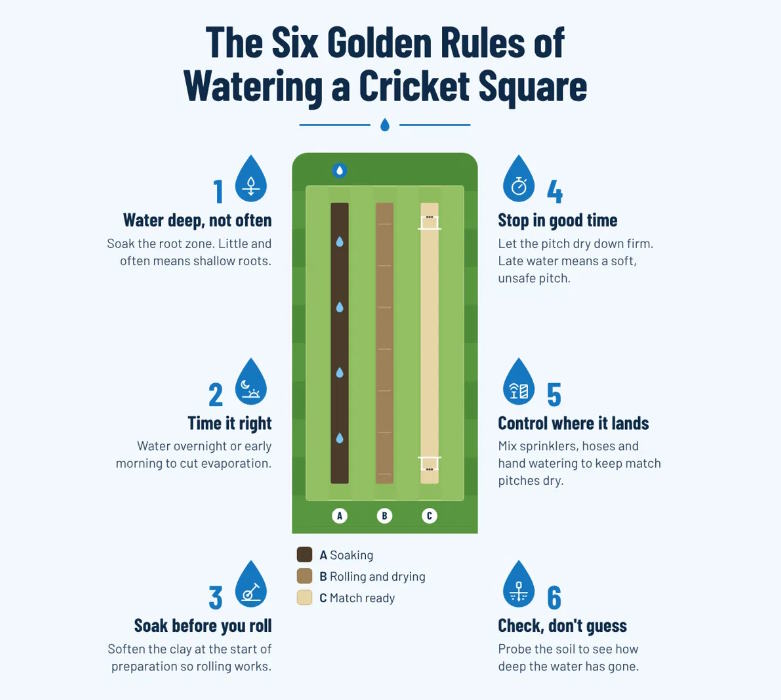
A cricket square needs water for two separate reasons: to keep the grass alive and to make the soil workable. The grass plant needs moisture to stay dense and deep-rooted, and that root mass is what binds the surface together through a long season. The clay soil, meanwhile, can only be rolled smooth and firm when it has been softened with water first. Without that, rolling achieves very little.
The challenge is that both needs peak at the same time of year. In midsummer, you may have one pitch being soaked ahead of preparation, another drying down for Saturday, and a used pitch that needs water to help it recover, all within a few metres of each other. That is why cricket pitch irrigation is more about control than volume.
In short: watering a square keeps the grass healthy and lets the clay be rolled into a firm, true surface.
When is the best time of day to water a cricket square?
The best time to water a cricket square is overnight or in the early morning, when it is cooler and less water is lost to evaporation and the grass itself. Evening watering is the next best option. Watering in the heat of the day is the least efficient, especially in wind, but if a volunteer can only get to the ground at lunchtime, watering then is still far better than letting the square dry out.
This is one of the strongest arguments for an automated system. An irrigation controller lets you set the sprinklers to run in the small hours without anyone needing to be on site, which saves both water and volunteer time.
In short: water overnight or early in the morning, and use a timer or controller to make that realistic.
How much water does a cricket square need?
The aim is to apply enough water for it to move down into the profile and draw the roots after it. Light, frequent sprinkles keep only the top few millimetres damp, which encourages shallow roots and leaves the surface drying and shrinking at a different rate from the soil beneath. That difference is a common cause of cracking and of surfaces that break up during play.
Rather than a fixed figure, judge it by the soil. Push a probe or screwdriver into the square after watering: if it goes in easily well below the surface, the water has penetrated. If it stops short, you need to water for longer or apply more slowly. On a compacted or hydrophobic square, a wetting agent can help water soak in rather than run off.
In short: water deeply and less often, and check penetration with a probe rather than relying on how the surface looks.
How often should you water a cricket square?
There is no set schedule, because frequency depends entirely on the weather, your soil and where you are in the pitch preparation cycle. In a cool, damp spring you may barely need to water. In a heatwave, you may need to water pitches on more days before preparation begins, or shorten the gap between preparation and the first match so they do not dry out too far.
What matters is avoiding the "little and often" habit. Several deep waterings a week will do far more for the square than a quick daily sprinkle.
In short: let the weather and the soil set the frequency, but always favour fewer, deeper waterings.
How do you water a pitch before match preparation?
Before preparation starts, give the pitch a thorough soak so the clay is soft enough to roll. Normal pitch preparation takes somewhere between seven and fourteen days, and that initial soak is what allows your rolling to do its job. As the pitch dries down, the rolling consolidates the soil and builds pace and bounce.
Timing is everything here. Water applied too close to the match will leave a soft, slow surface that can be dangerous. If the pitch is drying too quickly in hot weather, add small, even amounts by hand rather than reaching for the sprinkler, and keep an eye on the forecast. Covering a pitch after watering can slow the drying, but do not leave sheets on for long periods, as the grass still needs light and air.
In short: soak early to allow rolling, then stop in good time so the pitch dries firm for play.
What equipment is best for watering a cricket square?
Most clubs find that a combination of methods works best, because no single piece of kit handles every situation on a square. Here are the main options and where each one earns its place.
Pop-up sprinklers and automatic systems
An automatic system with pop-up sprinklers sunk around the square gives even coverage with very little labour, and it can run overnight on a timer. The drawback is that it is harder to keep individual pitches dry, although a well-designed system can split the square into halves or blocks controlled by separate valves. Those valves sit below ground in valve boxes at the edge of the square, safely away from play.
Travelling sprinklers and water tractors
A travelling sprinkler, often called a water tractor, uses the water pressure itself to pull the sprinkler along a hose or cable. It applies water evenly along a set run and shuts off automatically at the end, so it can be left unattended. Compact models such as the Nelson Rain Train water tractor are well suited to cricket squares, letting you water a strip of pitches while leaving others untouched.
Static sprinklers, hoses and hand watering
A static sprinkler on a stand is a simple, low-cost way to water larger areas of the square, especially pre-season and post-season when no pitches need to be kept dry. For precise work close to a pitch in preparation, nothing beats hand watering with a rose, backed up by a sprinkler hose laid alongside the strip. Good quality hoses and fittings make this far less of a chore.
If you would rather have a complete package designed around your square, our cricket square watering systems bring the right sprinklers, hose and fittings together in one place.
In short: use sprinklers or pop-ups for the whole square and hand watering, hoses or a water tractor where some pitches must stay dry.
How do you get water out to the cricket square?
Getting water to the middle of the ground is often a bigger headache than the watering itself. Running a long hose from a boundary tap works, but it has to be reeled out, reeled in and stored every time, and mains pressure often drops off over that distance.
A more convenient set-up is a buried supply pipe running under the outfield to a hydrant beside the square. Industry guidance recommends that this pipe is not connected directly to the mains, because of the risk of backflow contaminating drinking water. Instead, the mains fills a water storage tank acting as a break tank, typically 5 to 10 cubic metres for a cricket square, with an air gap between the inflow and the overflow. A submersible pump in the tank then pressurises the line out to the square.
Bury the pipe at least 600mm deep to protect it from frost, aeration tines and marquee pegs, and make sure the pipe is wide enough to deliver the pressure your sprinklers need. The hydrant itself should sit in a proper box with a secure lid so it never becomes a trip hazard. A break tank also gives you the option of topping up with harvested rainwater from the pavilion roof.
In short: a break tank, pump and buried pipe to a hydrant beside the square is the safest and most practical supply.
Can you water a cricket square during a hosepipe ban?
In many cases, yes, but with conditions. During the 2026 hosepipe bans, for example, Wiltshire Cricket confirmed that watering the square (pitches in use) was permitted under a health and safety exemption, while hosepipe use on the outfield and practice areas was not. Keeping that exemption meant changing how clubs watered: targeting only the pitches that need it, watering at cooler times and using covers to hold moisture in.
Restrictions vary between water companies and from one year to the next, so always check the current rules with your water supplier and your County Cricket Board. It is also worth letting neighbours know that the square is being watered under an exemption, as a sprinkler running in a drought can draw attention.
In short: square watering is often exempt from hosepipe bans for safety reasons, but check the current rules and water as efficiently as possible.
Does a cricket outfield need irrigating?
Most outfields in the UK are not irrigated, mainly because of the cost of the infrastructure and the large volume of water involved. Outfields are usually allowed to brown off in dry spells and recover when the rain returns. That said, outfield irrigation can make pre-season renovation far more successful, particularly where the ground is shared with winter sports. For larger areas, a hose reel irrigator or a bigger travelling sprinkler is usually the most cost-effective option, and our sports ground watering systems cover a range of field sizes.
In short: focus your water on the square first, and only irrigate the outfield where renovation or shared use justifies it.
Get the right watering set-up for your square
Whether you are a village club relying on volunteers or a school with a full-time grounds team, the right kit makes watering the square quicker, more accurate and far less wasteful. Browse our cricket square watering systems and travelling sprinklers, or give our team a call on 0800 316 0532. We offer full design, installation and after-sales support, and we are always happy to talk through your square, your water supply and your budget to find a system that works for your club.
Sources and further reading
- Grounds Management Association – Irrigating the cricket square
- Grounds Management Association – Water usage guidance for cricket squares and pitches in hot, dry weather
- Grounds Management Association – Effective and efficient watering in hot, dry weather
- Grounds Management Association – Is irrigating the outfield necessary?
- Wiltshire Cricket – Current hosepipe bans: guidance for cricket clubs (2026)
- Cricket Wales – Dry weather advice
- ECB – Recommended guidelines for the construction, preparation and maintenance of cricket pitches and outfields
Recent Posts
-

How to Water a Cricket Square: A Practical Guide to Cricket Pitch Irrigation
Ask any groundsman what makes or breaks a summer pitch, and water will be near the top of the list. …26th Nov 2026 -
How Does a Drip Irrigation System Work?
A drip irrigation system delivers water slowly and directly to the root zone of plants through a net …27th Oct 2026 -

What Is Drip Irrigation and When Should You Use It?
If you've spent any time researching efficient ways to water a garden, sports surface or equestrian …15th Oct 2026